Stretch Marks During Pregnancy: 9 Essential Facts Every Expecting Mother Should Know Pregnancy changes nearly every system in the body—and the skin is no exception. For many women, one of the most visible changes is the appearance of pregnancy stretch marks, medically known as striae gravidarum. They most commonly develop across the abdomen as the …
Stretch Marks During Pregnancy: 9 Essential Facts Every Expecting Mother Should Know
Pregnancy changes nearly every system in the body—and the skin is no exception. For many women, one of the most visible changes is the appearance of pregnancy stretch marks, medically known as striae gravidarum.
They most commonly develop across the abdomen as the baby grows, but they may also appear on the breasts, hips, thighs, buttocks, and lower back.
Stretch marks are extremely common and completely benign. They’re essentially a form of scar that develops when the skin expands faster than its collagen and elastin framework can comfortably accommodate.
For expecting mothers, however, stretch marks often raise questions:
Can they be prevented?
Does moisturizing help?
Are certain women more likely to develop them?
Will they disappear after pregnancy?
And if they remain after delivery, what can actually be done about them?
At En Santé Med in McLean, Virginia, we approach pregnancy-related skin changes with a long-term perspective. During pregnancy, the priority is healthy, gentle skin care and avoidance of unnecessary cosmetic procedures. After pregnancy and appropriate medical clearance, more targeted treatments may be considered for women who want to improve persistent stretch marks.
Here’s what expecting mothers should know.
1. What Are Pregnancy Stretch Marks?
Stretch marks are a type of dermal scar.
Healthy skin contains structural proteins called collagen and elastin. Together, they help skin remain strong while allowing it to stretch and rebound.
During pregnancy, the abdominal skin may expand substantially over a relatively short period. At the same time, hormonal changes can influence connective tissue.
When the deeper layers of the skin cannot adapt quickly enough, microscopic disruption of collagen and elastin can occur.
The result is a stretch mark.
Early stretch marks may appear:
- Pink
- Red
- Purple
- Reddish-brown
- Dark brown
Their appearance depends partly on natural skin tone.
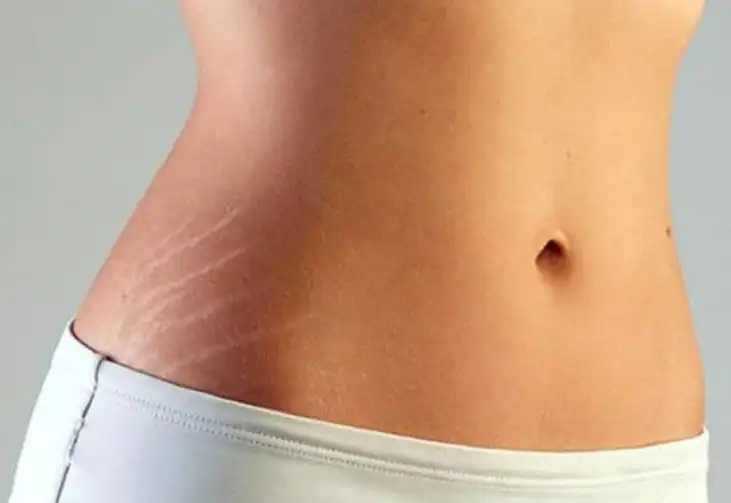
Over time, stretch marks generally become lighter and less noticeable. Mature stretch marks often appear pale, silvery, or slightly depressed.
They are not dangerous and do not represent a medical problem.
2. How Common Are Stretch Marks During Pregnancy?
Very common.
Pregnancy is one of the most frequent times for stretch marks to develop because several factors occur simultaneously:
Rapid abdominal expansion, hormonal changes, breast enlargement, weight gain, changes in connective tissue, and genetic predisposition may all contribute.
Some women develop only a few fine lines around the lower abdomen.
Others develop more extensive stretch marks involving the abdomen, breasts, hips, thighs, or buttocks.
Neither outcome means that a woman cared for her skin better or worse.
Genetics and individual skin biology matter considerably.
3. When Do Pregnancy Stretch Marks Usually Appear?
Stretch marks may appear at different times for different women, but they frequently become noticeable during the second half of pregnancy as abdominal expansion accelerates.
Some women first notice:
- Mild itching
- Tight-feeling skin
- Fine pink or red lines
- Increased sensitivity
before more visible marks develop.
The abdomen is the most common location, but stretch marks may also occur wherever tissue expands rapidly.
Common areas include:
Abdomen
The growing uterus places increasing mechanical tension on abdominal skin.
Breasts
Breast volume may increase significantly during pregnancy and again during breastfeeding.
Hips and thighs
Changes in body composition and weight distribution can contribute to stretching.
Buttocks
Pregnancy-related changes in fat distribution may create additional tension in this area.
4. Why Do Some Women Get More Stretch Marks Than Others?
Pregnancy alone doesn’t determine whether stretch marks appear.
Several factors influence risk.
Genetics
Family history appears to matter.
If your mother or sisters developed significant pregnancy stretch marks, you may have a greater predisposition.
Skin biology
Collagen density, elasticity, skin thickness, and connective-tissue characteristics vary considerably between individuals.
Degree and speed of skin expansion
Rapid changes can place greater mechanical stress on dermal tissue.
Hormonal influences
Pregnancy hormones can affect collagen and connective-tissue behavior.
Weight change
Greater or faster weight gain may increase mechanical stretching of the skin.
However, pregnancy is not the time to undertake restrictive dieting solely in an attempt to avoid stretch marks. Appropriate pregnancy weight gain should be discussed with your obstetric clinician based on your pre-pregnancy health and individual circumstances.
5. Can You Prevent Stretch Marks During Pregnancy?
Unfortunately, no method can guarantee that pregnancy stretch marks won’t develop.
Many products are marketed specifically for stretch-mark prevention, including:
Cocoa butter, shea butter, almond oil, vitamin E oil, coconut oil and specialized pregnancy creams.
These products can certainly hydrate the skin and improve comfort, particularly when abdominal skin feels dry or itchy.
But moisturizing should not be confused with guaranteed prevention.
The formation of stretch marks occurs in deeper dermal tissue, which means that surface moisturizers cannot fully control the biological process.
What should expecting mothers do instead?
Think in terms of supporting healthy skin rather than promising prevention.
A reasonable pregnancy skincare strategy may include:
- Regular moisturization
- Gentle cleansers
- Adequate hydration
- Balanced nutrition
- Appropriate pregnancy weight gain
- Sun protection
- Avoiding irritating skincare ingredients
- Discussing questionable products with your obstetrician
Most importantly, don’t blame yourself if stretch marks appear despite excellent skin care.
6. Does Moisturizing Still Matter?
Yes—just for a different reason.
Moisturizers may not reliably prevent stretch marks, but they can help improve the comfort and condition of expanding skin.
Pregnancy can make skin:
Dry, sensitive, tight, itchy, or reactive.
A bland, fragrance-free moisturizer can strengthen the skin barrier and reduce dryness.
Products containing ingredients such as ceramides or hyaluronic acid may help retain moisture, depending on the formulation.
Women with very sensitive skin may benefit from simpler formulations with fewer fragrances and botanical additives.
7. Which Stretch Mark Products Should Be Avoided During Pregnancy?
This is particularly important.
Avoid retinoids during pregnancy
Topical retinoids and retinol products should generally be avoided during pregnancy.
This includes ingredients such as:
- Retinol
- Tretinoin
- Tazarotene
- Adapalene
- Other vitamin A derivatives
Retinoids may eventually have a role in treating certain early stretch marks in nonpregnant patients, but they aren’t appropriate pregnancy skincare ingredients.
Before using any active skincare product during pregnancy, check the ingredient list and discuss questionable products with your obstetric clinician.
Be careful with aggressive cosmetic treatments
Pregnancy is also generally not the ideal time for elective procedures designed specifically to treat stretch marks.
At En Santé Med, our philosophy is simple:
Pregnancy is a time to support the skin—not aggressively remodel it.
More intensive corrective treatments can be considered after delivery when appropriate.
8. Will Pregnancy Stretch Marks Go Away After Delivery?
They usually improve substantially, but they may not disappear completely.
Immediately after pregnancy, stretch marks may remain:
Red, purple, pink or brown.
During the following months, they commonly become:
Flatter, paler and less noticeable.
This natural maturation process is important because postpartum stretch marks can look dramatically different several months after delivery than they do immediately after childbirth.
For that reason, treatment shouldn’t necessarily begin immediately.
Allowing the body time to heal provides a clearer picture of which stretch marks are likely to remain.
9. When Should You Consider Postpartum Stretch Mark Treatment?
There isn’t one universal timeline.
The appropriate timing depends on factors including:
- Delivery recovery
- Breastfeeding
- Hormonal changes
- Skin sensitivity
- Caesarean or other surgical healing
- Weight stabilization
- Overall health
- The age and color of the stretch marks
A personalized consultation is therefore more useful than choosing a treatment based simply on how long it has been since delivery.
At En Santé Med, postpartum skin restoration can be approached gradually.
The objective isn’t to erase evidence of pregnancy.
Instead, the goal is to improve the color, depth, texture and overall visibility of persistent stretch marks when they bother the patient.
What Actually Works for Postpartum Stretch Marks?
No treatment can guarantee complete stretch-mark removal.
However, appropriately selected treatments can often make them less noticeable.
The best strategy depends heavily on the type of stretch mark.
Early Red or Purple Stretch Marks
Newer stretch marks are often called striae rubrae.
They typically contain more visible vascular activity and inflammation than mature stretch marks.
Earlier stretch marks may respond differently than long-standing white scars.
Treatment planning may focus on reducing discoloration while stimulating healthier collagen remodeling.
Mature White Stretch Marks
Older stretch marks are known as striae alba.
They are often:
- White or silvery
- Slightly depressed
- Texturally different from surrounding skin
- More scar-like
These marks generally require treatment aimed at dermal remodeling rather than simply correcting color.
Postpartum Stretch Mark Treatments at En Santé Med
Depending on the skin type and characteristics of the stretch marks, En Santé Med may consider a multimodal strategy rather than relying on one modality.
Laser Skin Remodeling
Laser treatments can stimulate controlled tissue remodeling and collagen production.
Treatment parameters should be carefully adjusted based on:
Stretch-mark age, depth, location, skin tone and risk of post-inflammatory pigmentation.
For appropriate patients, fractional or resurfacing laser technologies may improve irregular texture and reduce the visual contrast between stretch marks and surrounding skin.
Er Laser Resurfacing
Er technology can precisely target superficial skin layers while encouraging controlled remodeling.
This can be especially useful when texture—not simply pigmentation—is the primary concern.
The depth and intensity of treatment can be customized rather than treating every stretch mark identically.
That customization is particularly important because postpartum stretch marks vary considerably between patients.
Radiofrequency Microneedling
RF microneedling combines mechanical microchannels with controlled radiofrequency energy delivered into the dermis.
The goal is to trigger wound-healing pathways and collagen remodeling while improving textural irregularity.
It may be appropriate for some mature stretch marks, particularly when the tissue has become slightly depressed.
Microneedling
Traditional microneedling creates controlled micro-injuries that stimulate the skin’s repair response.
It may be used alone or incorporated into a broader regenerative strategy depending on the patient.
PRP and Regenerative Approaches
Platelet-rich plasma may be paired with selected collagen-remodeling procedures in certain patients.
The concept is to support the tissue-repair environment rather than simply resurfacing the skin.
Treatment recommendations should always be individualized because evidence and outcomes vary between modalities.
Why Combination Therapy May Work Better Than One Treatment
Stretch marks aren’t simply a pigmentation problem.
They may involve:
Collagen disruption + elastin changes + vascular changes + epidermal changes + dermal thinning.
That is why En Santé Med may recommend a staged approach.
For example, one technology may primarily improve surface texture while another encourages deeper collagen remodeling.
Rather than asking:
“What is the best machine for stretch marks?”
a better question is:
“What combination best addresses the biology of my particular stretch marks?”
That distinction is central to personalized aesthetic medicine.
Pregnancy Stretch Marks and Skin of Color
Stretch-mark treatment requires particular attention in patients with medium to deeply pigmented skin.
Certain resurfacing procedures can trigger post-inflammatory hyperpigmentation (PIH) when treatment intensity, skin preparation or aftercare isn’t appropriate.
Treatment planning should therefore consider:
- Fitzpatrick skin type
- Existing pigmentation
- History of PIH
- Laser wavelength
- Treatment depth
- Energy settings
- Pre-treatment skin preparation
- Post-treatment inflammation control
At En Santé Med, treatment selection is based on the patient’s skin biology rather than applying identical settings to every patient.
Can You Treat Stretch Marks on the Abdomen After Pregnancy?
Yes.
The abdomen is one of the most commonly requested postpartum treatment areas.
Treatment can often be performed on stretch marks involving the:
Lower abdomen, upper abdomen, flanks, hips, thighs, breasts and buttocks.
However, postpartum abdominal concerns often involve more than stretch marks alone.
A woman may simultaneously experience:
- Skin laxity
- Changes in abdominal fat
- Muscle separation
- C-section scarring
- Crepey skin
- Textural changes
A comprehensive assessment can distinguish these concerns and determine which are appropriate for nonsurgical treatment.
Stretch Marks vs Loose Skin After Pregnancy
This distinction is important.
Stretch marks are scars within the skin.
Skin laxity is reduced firmness or elasticity of the tissue.
Many postpartum women have both.
Treating only the stretch marks may therefore improve texture without fully addressing looseness.
At En Santé Med, postpartum restoration may evaluate both skin quality and skin architecture.
Depending on the patient, a treatment plan may involve collagen stimulation, laser remodeling, skin tightening, resurfacing or combination therapy.
Frequently Asked Questions About Pregnancy Stretch Marks
Can I completely prevent stretch marks during pregnancy?
No proven method can guarantee prevention. Genetics, hormones, skin elasticity and the speed of tissue expansion all influence whether stretch marks develop.
Does cocoa butter prevent pregnancy stretch marks?
Cocoa butter can moisturize dry skin, but available evidence does not show that it reliably prevents pregnancy stretch marks.
Is vitamin E oil effective?
Vitamin E may moisturize the skin, but there is limited evidence that topical vitamin E alone prevents or eliminates stretch marks.
Can I use retinol on stretch marks while pregnant?
Retinoids, including retinol and tretinoin, should be avoided during pregnancy.
Do pregnancy stretch marks disappear?
They commonly fade and become less noticeable after pregnancy, although they may not disappear completely.
When should I treat stretch marks after pregnancy?
Timing should be individualized. Recovery from delivery, breastfeeding, hormonal changes, skin condition and the maturity of the stretch marks should all be considered before beginning elective treatment.
Is laser treatment effective for stretch marks?
Laser and light-based treatments may improve the appearance of certain stretch marks, but results depend on the type, age, depth and color of the marks as well as the patient’s skin type.
Does microneedling work for postpartum stretch marks?
Microneedling can stimulate dermal remodeling and may improve some stretch marks. RF microneedling may provide additional controlled energy within the dermis.
Can old white stretch marks still be treated?
Yes. Mature white stretch marks can often be improved, although they generally require collagen-remodeling treatment and usually aren’t completely erased.
How many treatments will I need?
There is no universal number. The treatment course depends on the extent and maturity of the stretch marks, treatment modality, skin type and individual healing response.
A Different Way to Think About Postpartum Skin
Pregnancy asks an extraordinary amount of the body.
Stretch marks aren’t evidence that the skin “failed.”
They are evidence that tissue adapted to profound physical and hormonal change.
For women who choose to improve them after pregnancy, modern aesthetic medicine offers increasingly sophisticated ways to stimulate collagen, improve texture and make stretch marks less visible.
But treatment should never begin with unrealistic promises.
At En Santé Med, our approach is based on evaluating the individual skin rather than prescribing the same procedure for every patient.
Postpartum Stretch Mark Treatment in McLean, Virginia
En Santé Med provides personalized skin-restoration consultations for women throughout McLean, Tysons, Great Falls, Reston, Arlington, Northern Virginia and the Washington, DC metropolitan area.
Treatment may incorporate laser resurfacing, collagen remodeling, microneedling, radiofrequency technologies or regenerative approaches based on the appearance and biology of the stretch marks.
If pregnancy stretch marks remain after delivery and continue to bother you, a personalized assessment can help determine what is realistic—and which treatment strategy makes sense for your skin.
Schedule a postpartum skin consultation with En Santé Med in McLean, VA to develop a personalized plan for improving stretch marks, skin texture and postpartum skin quality.
Medical note: This article is educational and does not replace individualized prenatal or postpartum medical advice. If you are pregnant or breastfeeding, discuss skincare products, medications and elective procedures with your obstetric or medical clinician before treatment.