Upper vs. Lower Blepharoplasty: 7 Key Differences and Which Eyelid Concerns Each Procedure Addresses Your eyes are often the first feature people notice. They communicate emotion, energy, and confidence. Yet the delicate skin surrounding the eyes is also one of the first areas to reveal visible signs of aging. Over time, collagen production declines, skin …
Upper vs. Lower Blepharoplasty: 7 Key Differences and Which Eyelid Concerns Each Procedure Addresses
Your eyes are often the first feature people notice. They communicate emotion, energy, and confidence. Yet the delicate skin surrounding the eyes is also one of the first areas to reveal visible signs of aging.
Over time, collagen production declines, skin elasticity decreases, and the supporting structures around the eyes change. These natural processes may lead to drooping upper eyelids, persistent under-eye bags, fine wrinkles, or hollow areas that create a tired appearance.
For many people, these changes become noticeable during their late 30s, 40s, and 50s. However, genetics, facial anatomy, sun exposure, and lifestyle can influence how early eyelid aging appears.
Blepharoplasty, commonly called eyelid surgery, is a procedure designed to improve the contour and appearance of the eyelids by removing or repositioning excess skin and fat.
But not all eyelid concerns require the same surgical approach.
Upper blepharoplasty primarily addresses excess skin and fullness affecting the upper eyelids. Lower blepharoplasty focuses on under-eye bags, protruding fat, and selected lower eyelid contour concerns.
Understanding the differences between upper and lower blepharoplasty helps patients make informed decisions about which treatment best matches their anatomy, expectations, and desired recovery time.
At En Santé Med, our physician-led philosophy emphasizes personalized facial rejuvenation, natural-looking outcomes, and thoughtful consideration of minimally invasive and non-surgical treatment options when clinically appropriate.
For patients who want to refresh the eye area without surgery, laser-based skin rejuvenation may offer an alternative for certain early signs of aging. However, non-surgical treatments cannot reproduce the structural changes achieved through blepharoplasty.
This guide explores the seven most important differences between upper and lower eyelid surgery, their benefits and limitations, recovery expectations, and when non-surgical options may be worth considering.
What Is Blepharoplasty?
Blepharoplasty is a surgical procedure that improves the appearance or function of the upper eyelids, lower eyelids, or both.
Depending on the patient’s anatomy, a surgeon may remove excess skin, reposition protruding fat, or modify supporting tissues to create a smoother eyelid contour.
The American Society of Plastic Surgeons identifies loose upper eyelid skin, excess fatty deposits, under-eye bags, and selected lower eyelid skin changes as concerns that blepharoplasty can address.
Blepharoplasty may be performed for two reasons.
Cosmetic Blepharoplasty
Cosmetic eyelid surgery focuses on improving appearance. Common goals include creating a more defined upper eyelid crease, reducing visible under-eye puffiness, or restoring a rested appearance.
Patients frequently describe feeling that their eyes look tired even when they sleep well.
Cosmetic blepharoplasty attempts to correct specific anatomical features that contribute to this appearance rather than simply changing the shape of the eyes.
Functional Blepharoplasty
Functional blepharoplasty addresses excess upper eyelid skin that interferes with normal vision or causes other documented functional problems.
Severe upper eyelid hooding may obstruct the superior visual field, making activities such as reading, driving, or working at a computer more difficult.
Functional surgery may qualify for insurance coverage when specific medical criteria are met. Cosmetic surgery generally does not.
Importantly, true eyelid ptosis, which occurs when the upper eyelid margin itself droops, may require a separate muscle-related surgical procedure rather than conventional skin-removal blepharoplasty.
Upper vs. Lower Blepharoplasty: Understanding the Anatomy
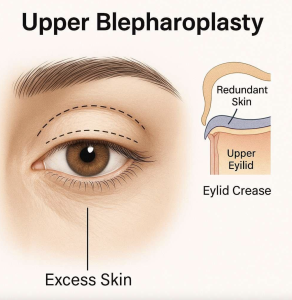
Upper blepharoplasty
Targets loose skin, hooding, and selected fat deposits above the eyes.
Lower blepharoplasty
Targets protruding under-eye fat, bags, and selected skin or contour changes below the eyes.
The upper and lower eyelids perform different anatomical functions. Consequently, the surgical techniques used to rejuvenate them differ.
The upper eyelids contain delicate skin, muscles responsible for eyelid movement, connective tissues, and orbital fat compartments. Their appearance can also be influenced by eyebrow position and forehead anatomy.
The lower eyelids provide protection and support for the eyes. Their appearance is influenced by fat compartments, skin elasticity, cheek volume, and the structural relationship between the lower eyelid and midface.
Because these regions age differently, patients may benefit from upper blepharoplasty, lower blepharoplasty, a combination of both, or another treatment entirely.
7 Key Differences Between Upper and Lower Blepharoplasty
| Feature | Upper Blepharoplasty | Lower Blepharoplasty |
| Primary concern | Excess upper eyelid skin and hooding | Under-eye bags and puffiness |
| Treatment area | Above the eye | Below the eye |
| Main objective | Restore upper eyelid contour | Smooth lower eyelid-to-cheek transition |
| Surgical incision | Usually within the upper eyelid crease | Inside lower lid or below eyelashes |
| Fat management | Conservative removal or repositioning when indicated | Removal or repositioning of protruding fat |
| Potential functional benefit | May improve vision affected by excess skin | Usually cosmetic |
| Recovery | Often 1–2 weeks of visible recovery | Often 1–2 weeks, sometimes longer for swelling |
These are general comparisons. The precise operation, risks, and recovery depend on individual anatomy and surgical technique.
What Does Upper Blepharoplasty Treat?
Upper blepharoplasty is designed to improve the contour of the upper eyelids by correcting excess skin and, when appropriate, selected fatty deposits.
As the skin ages, collagen and elastin fibers gradually lose their ability to support the delicate eyelid tissues. This can cause the upper eyelids to develop folds that obscure the natural eyelid crease.
1. Hooded Upper Eyelids
Hooded eyelids develop when excess skin folds over the upper eyelid crease, sometimes extending toward the eyelashes.
Although some people naturally have hooded eyes, age-related skin laxity can make hooding more noticeable.
Common concerns include:
- Upper eyelids appearing heavy or tired.
- Reduced visibility of the natural eyelid crease.
- Difficulty applying eyeliner or eye makeup.
- Skin resting directly on the eyelashes.
- Reduced peripheral vision in more advanced cases.
Upper blepharoplasty removes carefully selected excess skin while preserving enough tissue for normal eyelid closure and natural facial expression.
2. Excess Upper Eyelid Skin
Excess upper eyelid skin, medically called dermatochalasis, is one of the most common reasons patients consider blepharoplasty.
Dermatochalasis may develop because of aging, hereditary factors, or changes in skin elasticity.
In some cases, excess skin creates a noticeable fold that makes the upper eyelid look smaller or less defined.
Surgical removal can improve the eyelid contour. However, excessive tissue removal may cause an unnatural appearance, dry eye symptoms, or difficulty closing the eyes.
For this reason, conservative surgical planning is essential.
3. Upper Eyelid Puffiness
Not all upper eyelid fullness comes from loose skin.
Some patients have prominent fat compartments that contribute to a puffy appearance, particularly near the inner corners of the upper eyelids.
When appropriate, upper blepharoplasty may include conservative fat removal or repositioning.
The goal is to improve eyelid contour without producing an excessively hollow appearance.
4. Vision Obstruction From Excess Skin
When upper eyelid skin hangs low enough to interfere with vision, functional upper blepharoplasty may be considered.
Patients may notice difficulty seeing objects above them, constantly raising their eyebrows, or tilting their heads backward to improve visibility.
An ophthalmologist or oculoplastic surgeon may perform visual field testing and eyelid measurements to determine whether surgery is medically necessary.
5. Loss of Upper Eyelid Definition
Age-related skin laxity may conceal the natural upper eyelid crease.
By reducing excess skin, upper blepharoplasty can make the crease more visible and improve the relationship between the eyelid and eyebrow.
However, a low eyebrow can also create the appearance of upper eyelid hooding. In those cases, a brow lift or another approach may be more appropriate.
What Does Lower Blepharoplasty Treat?
Lower blepharoplasty addresses concerns beneath the eyes, particularly those associated with protruding orbital fat, changes in lower eyelid skin, and the transition between the lower eyelid and cheek.
Unlike upper blepharoplasty, which commonly focuses on removing redundant skin, lower blepharoplasty often requires careful fat repositioning and preservation of eyelid support.
1. Persistent Under-Eye Bags
Under-eye bags are among the most common reasons patients seek lower eyelid surgery.
They develop when fat surrounding the eyeball becomes more prominent beneath the lower eyelid.
Age-related changes in the supporting tissues may allow orbital fat to protrude forward.
Genetics can also contribute to under-eye bags, meaning some patients develop them relatively early in adulthood.
Lower blepharoplasty can address prominent fat compartments by removing or repositioning fat.
Important distinction: Temporary morning puffiness caused by fluid retention, allergies, or inadequate sleep may not improve with surgery because the underlying problem isn’t excess or displaced fat.
2. Lower Eyelid Skin Laxity
Thin, loose skin beneath the eyes may create a wrinkled or crepey appearance.
For patients with significant excess skin, lower blepharoplasty may include carefully planned skin removal.
However, removing too much skin can pull the lower eyelid downward and interfere with normal eyelid function.
Patients with mild skin laxity but without substantial under-eye bags may be candidates for non-surgical skin resurfacing rather than surgery.
3. Tear Trough Hollowing
The tear trough is the groove extending from the inner corner of the eye toward the upper cheek.
As facial tissues change with age, this groove may become more pronounced.
Tear trough hollowing can create shadows that make the under-eye area appear darker or more tired.
Modern lower blepharoplasty techniques may reposition existing fat to soften the transition between the lower eyelid and cheek.
However, surgery isn’t appropriate for every hollowing pattern. Some patients may need a different approach to volume restoration.
4. Under-Eye Wrinkles
Fine lines beneath the eyes may develop from a combination of collagen loss, repeated facial movement, sun exposure, and reduced skin elasticity.
Lower blepharoplasty can improve wrinkles associated with excess skin, but it does not necessarily eliminate fine lines or expression-related wrinkles.
Laser resurfacing and other collagen-stimulating treatments may be considered separately when skin texture is the primary concern.
5. Lower Eyelid Contour Irregularities
Some patients experience an abrupt transition between the lower eyelid and cheek, making the under-eye area appear swollen or uneven.
Lower blepharoplasty with fat repositioning may help create a smoother contour.
Because lower eyelid anatomy is complex, an individualized surgical approach is particularly important.
The American Academy of Ophthalmology emphasizes that lower eyelid surgery should be selected according to the patient’s anatomy rather than relying on one technique for every concern.
Upper vs. Lower Blepharoplasty: Which Procedure Is Right for Your Concerns?
The most useful starting point is to identify whether your primary concern is excess skin, protruding fat, skin texture, eyelid position, or a combination of these changes.
Explore treatment options by primary concern
Heavy, hooded upper eyelids
Persistent under-eye bags
Fine lines or mild crepey skin
Hollow tear troughs and dark shadows
Upper eyelid hooding and lower eye bags
POTENTIAL TREATMENT DIRECTION
Upper blepharoplasty may be appropriate when excess upper eyelid skin is the main concern. True eyelid ptosis or brow descent requires a separate assessment.
Educational guidance only. A clinical examination is necessary to determine the appropriate treatment.
Can Upper and Lower Blepharoplasty Be Performed Together?
Yes. Upper and lower blepharoplasty may be performed during the same surgical session when both regions require correction.
This combined procedure is sometimes referred to as four-lid blepharoplasty when all four eyelids are treated.
A combined approach may be considered for patients with substantial upper eyelid skin excess and persistent lower eyelid bags.
Potential advantages include coordinated treatment planning and a single recovery period rather than two separate operations.
However, combined surgery may involve more extensive swelling, and suitability depends on eye health, surgical risk, anatomy, and treatment goals.
Patients should discuss these considerations with a board-certified plastic surgeon, facial plastic surgeon, or appropriately trained oculoplastic surgeon.
Upper and Lower Blepharoplasty Surgical Techniques
Upper Eyelid Incision Technique
Upper blepharoplasty generally involves an incision placed within the natural upper eyelid crease.
Through this incision, the surgeon removes selected excess skin and may adjust fat or other tissues when necessary.
The incision is then closed using fine sutures.
Because the incision follows the eyelid crease, the resulting scar is often relatively inconspicuous after healing, although scar appearance varies.
Lower Eyelid Transconjunctival Approach
A transconjunctival lower blepharoplasty involves an incision inside the lower eyelid.
This approach is commonly considered when prominent orbital fat is the primary concern and substantial external skin removal is unnecessary.
One potential advantage is the absence of an external skin incision.
However, the procedure does not directly remove excess lower eyelid skin.
Lower Eyelid Transcutaneous Approach
A transcutaneous approach uses an incision just beneath the lower eyelashes.
This approach allows access to fat and skin and may be appropriate when both tissue changes need correction.
It requires careful attention to lower eyelid support and the risks of postoperative eyelid malposition.
The choice between techniques should be determined by a qualified surgeon after examining the eyelids.
Blepharoplasty Recovery: What Should Patients Expect?
Recovery is an important consideration, particularly for professionals balancing treatment with demanding work schedules, travel, and social commitments.
Although blepharoplasty is commonly performed as an outpatient procedure, visible healing may take several weeks.
- Days 1–3: Initial healing
Swelling, bruising, tightness, and temporary irritation are common. Cold compresses and head elevation may be recommended by the surgeon. - Days 4–7: Early improvement
Swelling may begin to decrease. Sutures may be removed during this period depending on the surgical technique. Bruising may remain visible. - Week 2: Returning to daily activities
Many patients feel comfortable resuming desk work and routine social activities, although residual bruising or swelling may persist. - Weeks 3–6: Continued refinement
Most visible bruising has often resolved. Lower eyelid swelling and changes in sensation may take longer to settle. Exercise is resumed according to the surgeon’s instructions. - Months 2–6 and beyond: Tissue maturation
Subtle swelling and scar changes continue to improve. Some patients require several months or longer to appreciate their final contour.
Is Lower Blepharoplasty Recovery Longer Than Upper Blepharoplasty?
Not necessarily, but lower eyelid surgery may involve additional techniques such as fat repositioning or structural support.
As a result, swelling may persist longer in some patients.
Recovery depends on the extent of surgery, individual healing, and the presence of complications.
What Are the Risks of Blepharoplasty?
Potential risks of upper or lower blepharoplasty include bleeding, infection, dry eyes, temporary blurred vision, difficulty closing the eyelids, unfavorable scarring, and asymmetry.
Lower eyelid surgery also carries a risk of eyelid retraction or ectropion, in which the lower eyelid turns outward.
Although rare, serious bleeding around the eye can threaten vision.
Patients who develop sudden vision loss, severe or rapidly worsening eye pain, or marked swelling after eyelid surgery require emergency medical evaluation.
Can You Improve Hooded Eyelids and Under-Eye Wrinkles Without Surgery?
Not every patient with early eyelid aging needs blepharoplasty.
Some individuals have relatively mild skin laxity, fine wrinkles, or changes in skin quality without substantial excess tissue or protruding orbital fat.
For these patients, non-surgical rejuvenation may offer more conservative options.
The distinction is important: surgery changes eyelid anatomy, while most non-surgical treatments primarily improve skin quality, texture, or modest laxity.
At En Santé Med in McLean, Virginia, our approach to facial rejuvenation emphasizes careful assessment of the underlying causes of aging before selecting a treatment.
For appropriate candidates, laser-based treatments may be considered as part of a personalized rejuvenation plan.
Laser Eyelid Tightening vs. Blepharoplasty
Laser skin rejuvenation works differently from surgical blepharoplasty.
Certain laser wavelengths deliver controlled energy to the skin to initiate tissue remodeling and improve the appearance of wrinkles and skin laxity.
Depending on the treatment settings, laser energy may stimulate collagen remodeling, resurface the skin, or produce controlled thermal contraction.
These effects can be valuable when early skin aging is the primary concern.
Fotona Laser Rejuvenation for the Eye Area
Fotona offers a non-ablative ER:YAG treatment protocol called SmoothEye that is designed for periocular skin tightening and wrinkle reduction.
According to the manufacturer, the treatment uses SMOOTH-mode laser energy to encourage collagen remodeling in the tissues surrounding the eyes.
Fotona
Potential treatment goals include:
- Improving mild crepey skin around the eyes.
- Reducing the appearance of fine periocular wrinkles.
- Improving skin texture and firmness.
- Supporting gradual collagen remodeling.
- Offering a non-surgical option with relatively limited downtime.
These outcomes should not be presented as equivalent to surgically removing excess eyelid skin or correcting protruding orbital fat.
Erbium Laser Resurfacing for Crepey Eyelid Skin
Er:YAG laser resurfacing may also be considered for selected patients with superficial wrinkles, photodamage, and textural changes.
Unlike non-ablative laser tightening, ablative resurfacing removes controlled layers of skin to promote renewal.
Treatment intensity determines the degree of downtime and risk.
Laser treatment near the eyes requires specialized training, appropriate patient selection, and proper ocular protection, including suitable intraocular shields when indicated.
Not every laser device or treatment protocol is appropriate for direct eyelid treatment.
Can Laser Treatment Replace Upper Blepharoplasty?
Laser rejuvenation may improve mild skin laxity, but it cannot reliably remove a substantial fold of redundant upper eyelid skin.
Patients with severe hooding or visual field obstruction usually need evaluation for a surgical solution.
Similarly, laser treatment doesn’t correct true upper eyelid ptosis.
Can Laser Treatment Replace Lower Blepharoplasty?
Laser treatments may help improve fine lines and mild laxity beneath the eyes.
However, they cannot reposition large protruding orbital fat compartments or provide the anatomical correction achieved with lower blepharoplasty.
For persistent structural under-eye bags, surgery may provide a more appropriate solution.
Upper vs. Lower Blepharoplasty vs. Non-Surgical Laser Rejuvenation
| Concern | Upper Blepharoplasty | Lower Blepharoplasty | Laser Rejuvenation |
| Upper eyelid hooding | Often appropriate | No | Yes |
| Excess upper eyelid skin | Yes | No | Mild to moderate |
| Under-eye fat bags | No | Yes | Yes |
| Crepey skin | Limited benefit | May improve selected cases | Often considered |
| Fine wrinkles | Limited benefit | Limited benefit | Yes |
| Tear trough hollowing | No | May help with fat repositioning | Moderate improvement |
| Surgical incisions | Yes | Yes | No surgical incision |
| Typical downtime | Days to weeks | Days to weeks | Varies by laser technique |
The choice depends on the structural cause of the concern and the degree of correction desired.
Why the Right Diagnosis Matters More Than the Treatment Name
One of the most common mistakes in eyelid rejuvenation is assuming that every tired-looking eye requires the same procedure.
In reality, several different anatomical changes can create a similar appearance.
Drooping Eyelids vs. Drooping Eyebrows
Some patients believe they have excess upper eyelid skin when the primary cause is actually downward movement of the eyebrows.
Others have both brow descent and redundant eyelid skin.
Removing upper eyelid skin without assessing eyebrow position may produce an incomplete result.
Under-Eye Bags vs. Malar Festoons
Malar festoons are swollen or lax tissue folds that typically develop lower on the upper cheeks, beneath the lower eyelid.
They are different from conventional under-eye fat bags.
Standard lower blepharoplasty may not correct festoons and can occasionally make certain contour concerns more apparent.
A specialized assessment is therefore necessary.
Dark Circles vs. Under-Eye Hollowing
Dark circles may result from pigmentation, visible blood vessels, shadows, thin skin, or volume loss.
Lower blepharoplasty may improve shadows created by protruding fat and associated hollowing, but it does not directly treat every cause of under-eye discoloration.
Fine Lines vs. Skin Redundancy
Fine lines caused by surface aging may respond to resurfacing treatments.
Large folds of excess skin usually require a different approach.
Accurately identifying the problem helps patients avoid unnecessary treatments and unrealistic expectations.
How Aging Affects the Eyelids in Your 30s, 40s, and 50s
Eyelid Rejuvenation in Your 30s
During the 30s, early signs of periocular aging may include fine lines, mild texture changes, and subtle reductions in skin elasticity.
Some individuals also have hereditary under-eye bags or naturally hooded eyelids.
When skin changes are mild, non-surgical treatments and preventive skin care may be reasonable options.
Eyelid Rejuvenation in Your 40s
During the 40s, changes in facial volume, collagen, and skin elasticity may become more noticeable.
Perimenopausal hormonal changes can also contribute to skin dryness and altered skin quality in some women.
Common concerns include upper eyelid heaviness, fine wrinkles beneath the eyes, and increasingly prominent under-eye bags.
Treatment selection should be based on anatomy rather than age alone.
Eyelid Rejuvenation in Your 50s and Beyond
During the 50s and beyond, patients may notice more advanced skin laxity and changes in the structural support of the eyelids.
For some, surgery may provide a more substantial correction than non-surgical treatments.
However, patients with mild changes may still prefer conservative rejuvenation strategies.
Healthy skin care habits, sun protection, and appropriate maintenance treatments can complement either approach.
How Long Do Blepharoplasty Results Last?
Blepharoplasty can produce long-lasting improvements, although it doesn’t stop the natural aging process.
Upper blepharoplasty results often remain noticeable for many years. Lower blepharoplasty results may also be long-lasting, especially when structural fat prominence is successfully corrected.
The duration of results varies according to genetics, skin elasticity, facial aging, sun exposure, and surgical technique.
Non-surgical laser rejuvenation generally produces more modest improvements, and maintenance treatments may be needed.
How Much Does Upper vs. Lower Blepharoplasty Cost?
The cost of blepharoplasty varies based on geographic location, surgical complexity, anesthesia, facility fees, and the qualifications of the surgeon.
Upper blepharoplasty and lower blepharoplasty may have different costs because they involve different techniques and levels of complexity.
Combined surgery typically costs more than an individual procedure, although it may avoid some duplicated facility or anesthesia expenses.
Patients considering blepharoplasty in Northern Virginia or the Washington, DC metropolitan area should request an individualized surgical estimate.
For non-surgical laser rejuvenation, costs depend on the treatment area, treatment intensity, and number of recommended sessions.
Choosing Between Blepharoplasty and Non-Surgical Eye Rejuvenation in McLean, VA
Choosing the right treatment starts with understanding your goals.
Some patients want a significant correction of excess skin or prominent under-eye bags.
Others want a subtle improvement in fine lines, skin quality, and firmness without surgical downtime.
Neither approach is universally better.
For patients in McLean, Tysons, Great Falls, Reston, Fairfax, and the greater Washington, DC metropolitan area, the most appropriate plan should balance clinical findings, desired outcomes, downtime, and individual preferences.
At En Santé Med, our physician-led approach emphasizes facial balance, natural-looking rejuvenation, and conservative treatment planning.
Our aesthetic philosophy favors improving skin quality and supporting healthy tissue remodeling when those methods can reasonably address the patient’s concerns.
When anatomical changes require surgical correction, consultation with an appropriately qualified surgical specialist is the more suitable next step.
Frequently Asked Questions About Upper vs. Lower Blepharoplasty
1. What is the main difference between upper and lower blepharoplasty?
Upper blepharoplasty primarily addresses excess skin and selected fat deposits above the eyes. Lower blepharoplasty primarily corrects prominent under-eye fat bags and selected lower eyelid contour changes.
2. Which is better for hooded eyes?
Upper blepharoplasty may be appropriate when excess upper eyelid skin causes hooding. However, if the problem is related to brow position or true eyelid ptosis, another procedure may be needed.
3. Which procedure removes under-eye bags?
Lower blepharoplasty is commonly used to correct under-eye bags caused by protruding orbital fat. Fluid retention, allergies, and other medical causes of puffiness require different management.
4. Can upper blepharoplasty make your eyes look bigger?
Upper blepharoplasty can make the eyes appear more open when excess skin obscures the natural eyelid contour. It does not enlarge the eyeball.
5. Does lower blepharoplasty remove dark circles?
It may improve shadows associated with protruding fat or tear trough contour changes. However, pigmentation-related dark circles and visible blood vessels usually require other approaches.
6. Is upper blepharoplasty less invasive than lower blepharoplasty?
Both are surgical procedures. Upper blepharoplasty is often relatively straightforward, while lower blepharoplasty may require more complex fat repositioning or eyelid support techniques.
The complexity of either procedure depends on the patient.
7. Is blepharoplasty painful?
Discomfort after surgery is often manageable with prescribed postoperative care, although patients may experience tightness, swelling, irritation, and bruising.
Pain that is severe, rapidly worsening, or associated with changes in vision requires urgent medical attention.
8. Can laser treatment tighten upper eyelids?
Certain laser treatments may improve mild skin laxity and wrinkles surrounding the eyes. However, laser rejuvenation cannot reliably correct severe upper eyelid hooding or vision obstruction.
9. Is non-surgical blepharoplasty the same as laser eyelid tightening?
No. The term non-surgical blepharoplasty is sometimes used in marketing, but laser eyelid tightening does not involve surgical removal or repositioning of skin and fat.
Patients should understand precisely what a proposed procedure can and cannot accomplish.
10. Can Botox replace blepharoplasty?
Botulinum toxin may improve some expression-related wrinkles and, in selected patients, subtly influence eyebrow position.
However, it does not remove excess eyelid skin or correct significant under-eye fat bags.
Improper injection placement can also temporarily worsen eyelid or brow drooping.
11. Can I have upper and lower blepharoplasty at the same time?
Yes. Both procedures may be combined when clinically appropriate. A qualified surgeon must assess the patient’s anatomy, eye health, and surgical risk.
12. What is the best age for blepharoplasty?
There is no single ideal age. Candidates may seek treatment in their 30s, 40s, 50s, or later.
The decision depends primarily on anatomy, symptoms, overall health, and personal treatment goals.
13. Does insurance cover upper or lower blepharoplasty?
Insurance may cover functional upper blepharoplasty when documented excess skin interferes with vision and the patient meets the insurer’s criteria.
Cosmetic upper and lower blepharoplasty are generally not covered.
14. Can laser resurfacing be performed after blepharoplasty?
In selected patients, laser resurfacing may be used as an adjunct to surgery or performed after sufficient healing.
Timing and suitability should be coordinated with the surgeon. Treatment close to the eyes requires appropriate ocular safety measures.
15. Can blepharoplasty results look natural?
Yes, natural-looking results are an important surgical goal. Preserving eyelid function, maintaining appropriate tissue volume, and avoiding excessive removal of skin or fat are essential considerations.
Final Thoughts: Choosing the Right Approach to Eyelid Rejuvenation
The decision between upper and lower blepharoplasty begins with one essential question: What is causing your eyelids to look heavy, tired, puffy, or aged?
If excess upper eyelid skin is the primary problem, upper blepharoplasty may offer an effective surgical correction.
If persistent under-eye bags are caused by protruding orbital fat, lower blepharoplasty may be more appropriate.
When concerns are limited to mild crepey skin, fine wrinkles, or early skin laxity, non-surgical laser rejuvenation may provide a more conservative option.
At En Santé Med, we believe facial rejuvenation should reflect the individual rather than follow a one-size-fits-all approach.
Our goal is to help patients make informed decisions about skin health, facial aging, and treatment options while prioritizing natural-looking outcomes and appropriate medical care.
Explore Non-Surgical Eye Rejuvenation at En Santé Med in McLean, Virginia
For women and men seeking a refreshed appearance without unnecessary intervention, En Santé Med offers a physician-led approach to aesthetic rejuvenation.
Whether you’re noticing early eyelid laxity, fine wrinkles, or age-related changes in the delicate skin surrounding your eyes, a personalized consultation can help identify appropriate non-surgical options.
Explore how laser-based rejuvenation may support improved skin texture, firmness, and overall facial harmony.
En Santé Med | Physician-Led Medical Aesthetics and Wellness
Serving McLean, Tysons, Great Falls, Reston, Fairfax, and the greater Washington, DC metropolitan area.
Schedule a consultation to explore personalized facial and periocular rejuvenation options.
Medical disclaimer: This article is intended for educational purposes and does not replace individualized medical advice. Blepharoplasty is a surgical procedure requiring evaluation by an appropriately qualified surgeon. References to Fotona periocular treatment describe a technology and do not establish that every protocol discussed is available at En Santé Med. Treatment availability, candidacy, expected benefits, and potential risks must be confirmed during consultation.